

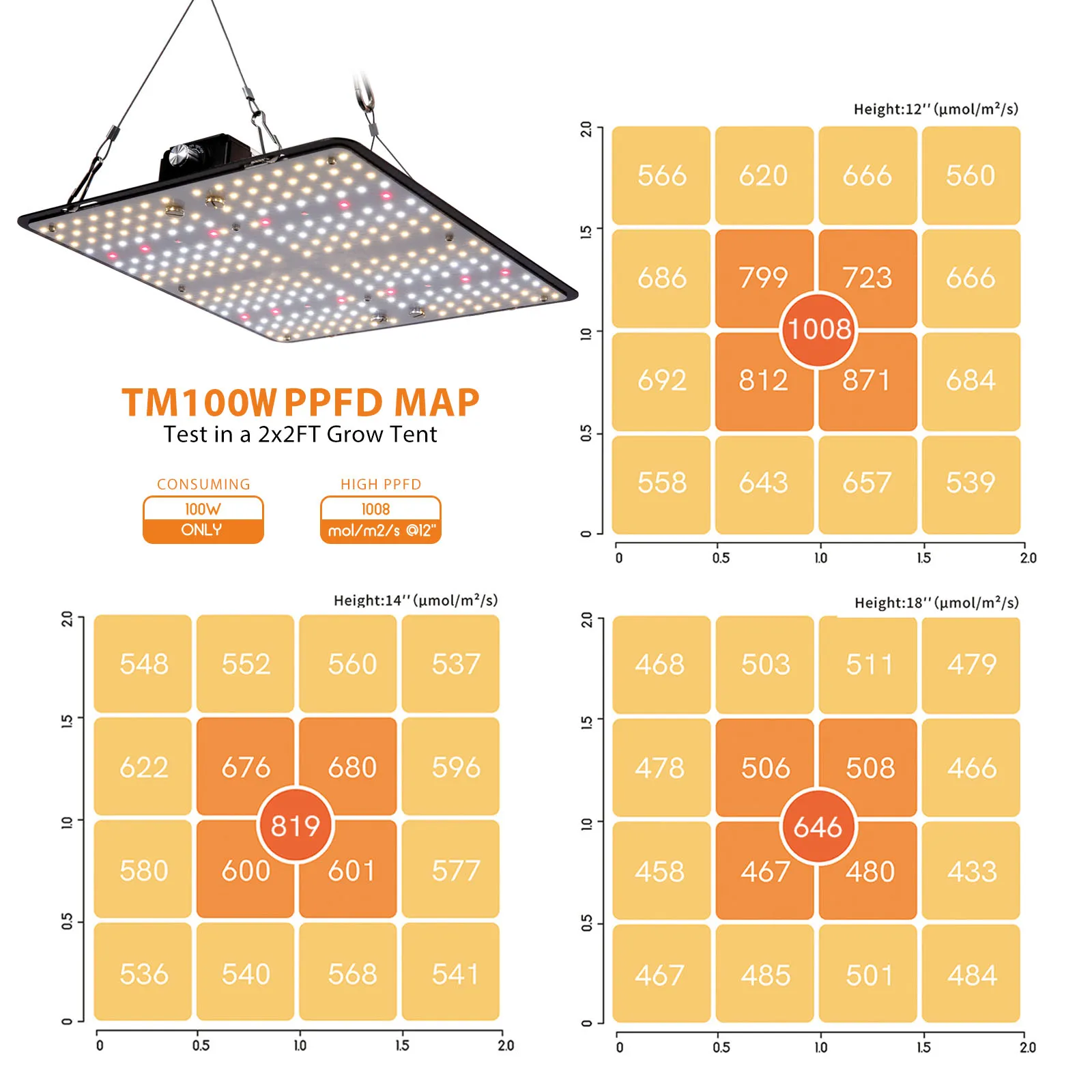
What is grow light distance chart for LED? Actually it should be called PAR chart or PPFD map.
PAR (Photosynthetically Active Radiation) value chart. It refers to the optic radiation energy in the wavelength range of 400 - 700 nanometers that can be utilized by plant photosynthesis. It is usually measured by photon flux density, with the unit of micromoles per square meter per second (μmol/(m²·s)).
The grow light distance chart LED (PAR value chart) is used to record and display the intensity data of photosynthetically active radiation under different environmental conditions. Through the PAR value table, we can understand the amount of light energy available for photosynthesis received by plants under specific time, location, and environmental factors. It helps people evaluate the impact of light conditions on plant growth, development, and photosynthetic efficiency.
The Relationship Between LED Grow Light Hanging Height and PPFD:
A Case Study of 100W Quantum Board LED Panels
Core Impact of Hanging Height on PPFD
PPFD (Photosynthetic Photon Flux Density, measured in μmol/m²/s) is a critical parameter for determining the actual light energy received by plant canopies, and its value is directly influenced by the hanging height of the grow light.
Some grow light distance chart led, for a 100W Quantum Board LED panel, lowering the hanging height significantly increases PPFD values but risks creating uneven light distribution, such as a central "hotspot" (peak PPFD) and dimmer edges. For example, experiments show that reducing the hanging height from 60 cm to 30 cm may boost the central PPFD from 150 μmol/m²/s to 250 μmol/m²/s, while edge regions could experience over 50% light attenuation. Thus, balancing intensity and uniformity requires referencing a "grow light distance chart led" for optimal setup.
Interpreting Light Distribution Maps and Photometric Data
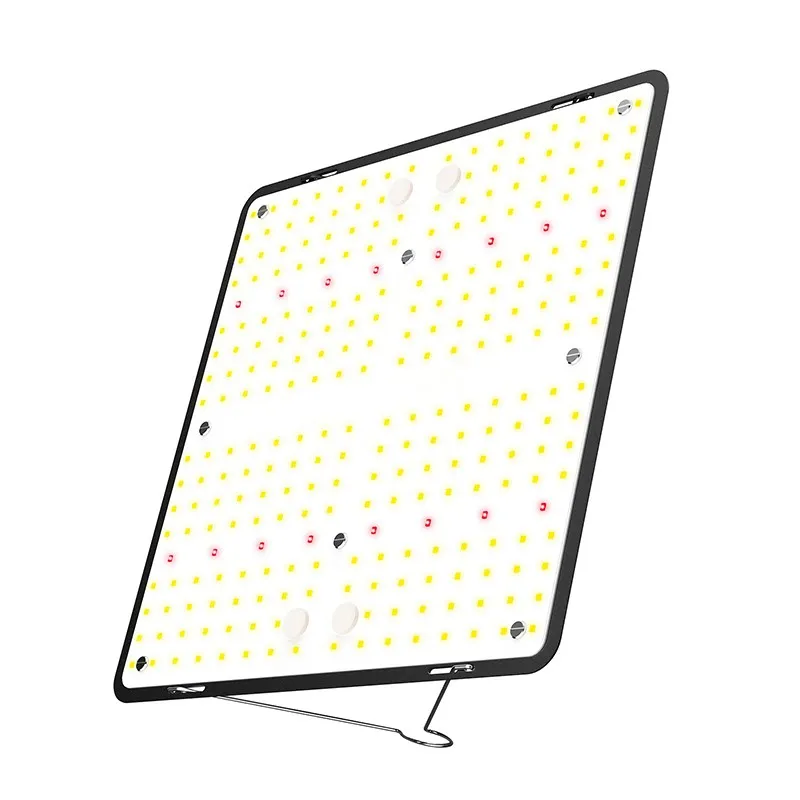
Light distribution maps (e.g., isolux curves) and photometric curves (angular light intensity distribution),that means grow light distance chart led are essential tools for optimizing hanging height:
Photometric Curve: Reflects the beam angle of the fixture. A 100W Quantum Board with a 120° beam angle provides broad coverage but slower PPFD decay over distance, whereas a narrow 60° beam angle demands greater height for uniform coverage.
Isolux Map: Simulated or measured PPFD spatial distribution at varying heights. For instance, Figure 5A reveals a 44% PPFD difference between the central hotspot and edges in a 1m×1m area, necessitating adjustments via a "grow light distance chart led" to ensure uniformity.
Hanging Height Recommendations for 100W Quantum Boards
Based on typical parameters (120° beam angle, red-blue spectrum blend):
Seedling Stage: Hang at 60–80 cm (PPFD 100–150 μmol/m²/s) to avoid light stress and seedling burned.
Vegetative Stage: Lower to 30–50 cm (PPFD 200–300 μmol/m²/s) to maximize photosynthesis.
Flowering/Mature Stage: Adjust for crop type-e.g., leafy greens require higher uniformity, maintained at 40 cm with supplemental side lighting.
Always cross-reference manufacturer-provided grow light distance chart led guidelines with real-world PPFD measurements.
According grow light distance chart led Strategies to Improve Light Distribution Uniformity
Multi-Light Layouts: Reduce fixture spacing or adopt multi-tiered setups if single-panel coverage is insufficient.
Dynamic Adjustments: Use adjustable hangers to modify height as plants grow, aligning with their evolving light needs.
Measurement Tools: Validate PPFD distribution with a spectroradiometer (Figure 4A) or simulate light spread using IES files.
Common Pitfalls and Solutions
Pitfall 1: Overprioritizing high PPFD, causing leaf burn.
Solution: Gradually lower height using a "grow light distance chart led" while monitoring leaf temperature.
Pitfall 2: Ignoring spectral impacts on PPFD requirements.
Solution: Adjust hanging height based on red (660nm) and blue (450nm) ratios (e.g., 3:1), which influence photosynthetic efficiency.